

Few figures in rock history carry an aura as enduring and enigmatic as Jimmy Page.
Guitarist, producer, and chief architect of Led Zeppelin, Page didn’t merely create some of the most iconic riffs in popular music — he built a complete artistic identity rooted in symbolism, discipline, and the conscious application of creative will.
Across decades, his association with the occult has inspired fascination, exaggeration, and mythmaking. Yet when stripped of sensationalism, what remains is far more compelling: the occult as method, intellectual framework, and creative structure, rather than spectacle or provocation.
Occultism as Cultural Language in the 1960s and 1970s
To understand Jimmy Page’s interest in the occult, one must first understand his era.
During the 1960s and 1970s, occultism was not a fringe obsession. It flowed directly into the counterculture, alongside psychedelic exploration, Eastern philosophy, mythological revival, and a broad rejection of rigid postwar religious frameworks.
Tarot, alchemy, Hermetic symbolism, ceremonial magic, and Kabbalah circulated freely among artists, writers, filmmakers, and musicians. These systems were often approached not as literal belief structures, but as alternative symbolic languages — tools for understanding identity, intention, and transformation.
Jimmy Page emerged from this environment not as an eccentric outlier, but as one of its most focused and disciplined interpreters.
Intellectual Curiosity and Creative Discipline
Unlike the chaotic excess often associated with 1970s rock mythology, Page’s engagement with the occult was rooted in study and concentration. He was a serious reader with a long-standing interest in history, mythology, philosophy, and symbolic systems.
His curiosity extended across multiple traditions:
- Western ceremonial magic
- Medieval alchemy
- Hermetic symbolism
- British esoteric traditions
- Eastern philosophies
This eclectic approach mirrors his music. Just as he absorbed blues, folk, Middle Eastern scales, and Indian textures into a new musical language, Page approached occultism as raw intellectual material — not dogma, but structure.
Aleister Crowley Beyond the Caricature
No name is more closely associated with Page than Aleister Crowley, and few figures are more frequently misunderstood.
Crowley is often reduced to a caricature: a “dark magician,” a provocateur, a satanic figure. In reality, he was a complex and controversial thinker concerned with self-knowledge, mental discipline, and individual freedom.
At the core of his philosophy, Thelema, lies the concept of True Will — not impulsive desire, but the discovery and execution of one’s deepest purpose.
For Page, this idea resonated strongly with artistic creation. Making music, at its highest level, required clarity of intention, rejection of compromise, and absolute commitment to a vision.
👉 Crowley’s ideas would later ripple far beyond occult circles, shaping counterculture and rock history — influencing figures connected to the Beatles, the hippie movement, Raul Seixas, Ozzy Osbourne, and many others.
Boleskine House and the Physical Symbol
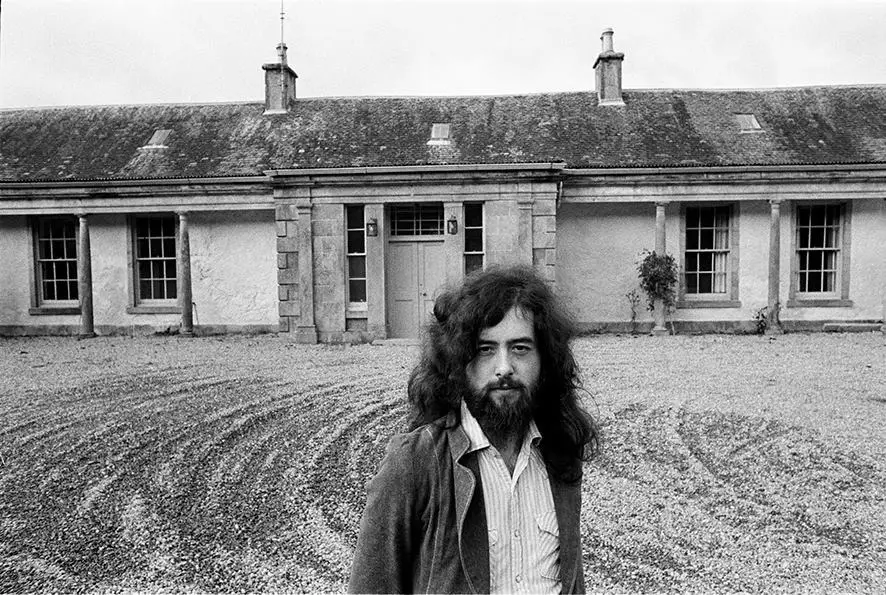
In 1971, Page purchased Boleskine House, a former residence of Crowley located on the shores of Loch Ness. The acquisition fueled countless conspiracies and myths.
In reality, Page rarely lived there. The house functioned primarily as a symbolic anchor — a physical connection to Britain’s esoteric lineage rather than a site of ritual practice.
Nevertheless, the public image of Page as the “magician of rock” became cemented.

Will, Control, and the Role of the Producer
This philosophy manifests clearly in Page’s role as producer for Led Zeppelin.
Unlike many guitarists of his era, Page exercised near-total control over:
- recording techniques
- mixing decisions
- studio selection
- track sequencing
- visual identity
- release strategy
This control was not about ego. It was about aesthetic coherence.
In esoteric traditions, intention without form dissolves. Page seemed to understand intuitively that sound, image, and atmosphere must operate as a unified system. Each Led Zeppelin album functions as a closed world, governed by its own internal logic.
Symbols, Sigils, and the Power of the Unexplained
The most iconic expression of this mindset appears on Led Zeppelin IV. By removing the band’s name and album title from the cover and replacing them with four symbols, Page shifted focus from explanation to experience.
His personal symbol — commonly referred to as Zoso — echoes alchemical signs and magical sigils. In esoteric traditions, sigils are not meant to be intellectually decoded. They operate through association, repetition, and intention.
Page’s refusal to explain the symbol was not a marketing trick. It was symbolic consistency.
In occult philosophy, over-explanation weakens power.
Sound as Ritual Experience
Musically, Page’s engagement with the occult is expressed less through lyrics than through sonic architecture.
He explored:
- modal and Eastern scales
- alternate tunings
- drones and sustained textures
- extreme contrasts between silence and explosion
- hypnotic, cyclical structures
“Kashmir” functions like a rhythmic mantra. “No Quarter” evokes isolation and inner descent. “In the Light” builds tension and release with ritualistic precision.
The music ceases to be linear storytelling and becomes immersive experience.
Equinox: Books as an Extension of the Search
This commitment to study and intellectual depth did not remain abstract. At a certain point, it took physical form.
In December 1973, Jimmy Page became co-owner of Equinox Books, a London bookstore devoted to esotericism, occult philosophy, symbolism, alternative history, and comparative spirituality. Located at 4 Holland Street, London, Equinox was not a novelty shop or a place driven by sensationalism. It focused on rare books, critical editions, and serious research material connected to Western and Eastern esoteric traditions.
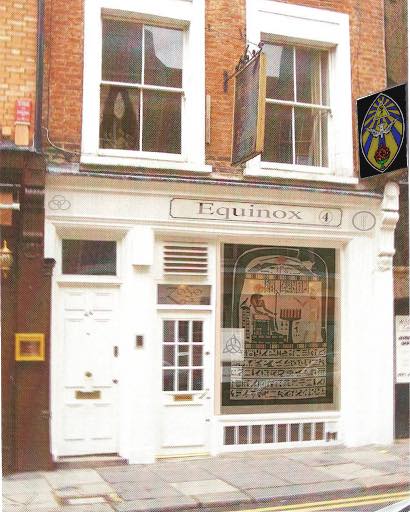
Page’s involvement with Equinox reinforces a central aspect of his relationship with the occult: this was about knowledge, preservation, and continuity, not performance or provocation. The bookstore functioned as a public extension of his private library — a space where the occult was treated as cultural and philosophical inquiry rather than spectacle.
Today, the original Equinox location no longer operates as a bookstore. The space at 4 Holland Street is now home to a gallery run by photographer Richard Young, marking a quiet but symbolic transition — from printed esoteric knowledge to visual documentation of rock history itself.
Moral Panic, Accusations, and Strategic Silence
During the late 1970s and 1980s, heavy rock, occult symbolism, and massive popularity collided with moral panic. Accusations of satanism, hidden messages, and dark rituals became commonplace.
Page never fed these narratives. He neither confirmed nor denied them in detail.
This silence was deliberate.
In classical occult traditions, knowledge is not defended through explanation. It is preserved through discretion. Those seeking spectacle find projection; those seeking understanding find layers.
Between Myth and Method
Jimmy Page is neither a literal sorcerer nor a fictional character. He is an artist who deeply understood that sound, symbol, intention, and discipline are interconnected.
Occultism, for Page, was not an end goal. It was a method for organizing focus and creative will. The myth grew because he never dismantled it — but he never exploited it either.
Why It Still Resonates
Decades later, Page’s music retains its tension, mystery, and sense of purpose. In an era of constant explanation and exposure, his work reminds us that not everything needs to be said to be felt.
In this context, the occult is not shock value or belief system.
It is method.
It is silence.
It is will, applied to creation.
And perhaps that is why Jimmy Page’s work remains alive — dense, unsettling, and endlessly compelling.